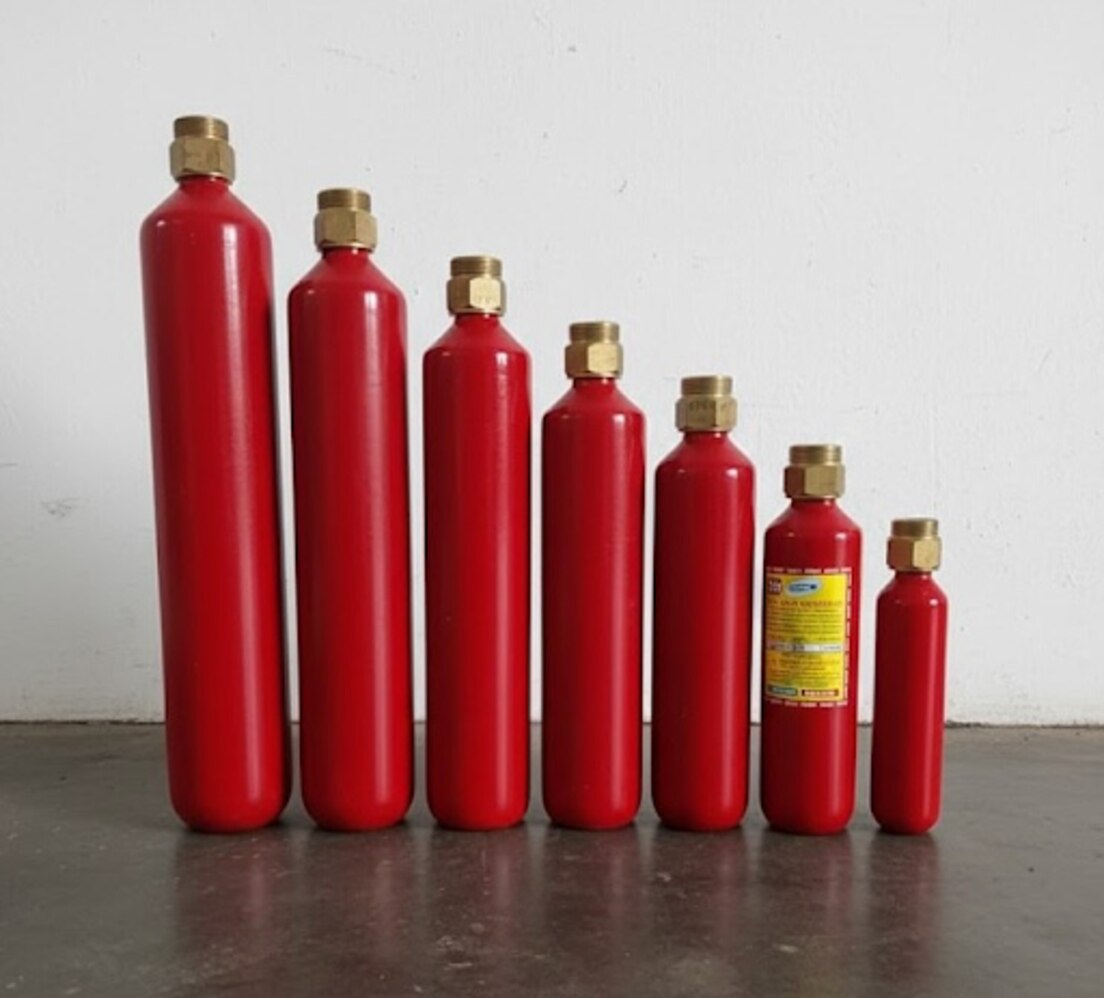
A 60 g, 100 g, or 300 g label does not prove that a CO2 cartridge will operate your extinguisher, actuator, or suppression unit correctly. You will be able to match the charge, connection, pressure behaviour, documentation, and condition of a cartridge to the equipment before accepting or installing it.
Key takeaways
- Match the cartridge charge to the equipment nameplate and approved parts list.
- Measure threads, length, diameter, neck, seal, and actuator clearance before ordering.
- Check service temperature, working pressure, filling limits, and compatible sealing materials.
- Reject cartridges without legible batch details, test records, and traceable certification.
Match the CO2 charge to the equipment, not to the catalogue range
The equipment nameplate, installation manual, approved parts list, and actuator or suppression-unit specification determine the CO2 cartridge capacity—not the broad 60 g to 300 g catalogue range. Request the supplier’s complete size schedule and verify exact nominal charges.
Make a 60 g CO2 cartridge, 100 g CO2 cartridge, 150 g CO2 cartridge and 200 g CO2 cartridge availability check, then verify 300 g CO2 cartridge range facts with the supplier rather than assuming catalogue sizes.
| Term | Meaning | Check |
|---|---|---|
| Net CO2 fill mass | CO2 inside the sealed cartridge | Confirm the nominal charge and specified fill tolerance |
| Tare mass | Empty cartridge mass, including fixed valve parts | Read the marked tare |
| Gross weight | Tare mass plus actual CO2 mass | Compare with the permitted gross range |
| Cylinder water capacity | Internal volume measured by water capacity | Confirm the specified internal volume and maximum filling ratio |
- Request the actual net mass, permitted fill tolerance, internal volume, maximum filling ratio, and replacement charge. Two cartridges with the same nominal mass can produce different actuator performance because valve design, dip-tube arrangement, and fill tolerance affect discharge.
- Record the marked tare, weigh the sealed cartridge on a calibrated scale, and compare the result with the permitted net and gross ranges. A pressure reading alone cannot confirm charge: while liquid CO2 remains, pressure follows temperature and can appear normal after charge loss.
Verify the cartridge’s physical fit and discharge behaviour
Confirm cartridge compatibility against the actual equipment, not against a cartridge that merely screws into the holder. Photograph and record the equipment nameplate, manufacturer part number, cartridge holder, thread form, thread specification and pitch check, neck profile, valve design, piercing mechanism, sealing face, shoulder diameter, insertion depth, and permitted tightening torque.
Compare every measurement with the installation manual and approved replacement-part list. A similar-looking thread can leak, bottom out, or miss the seal; a different piercing-pin position can fail to puncture the cartridge.
| Check | Liquid CO2 discharge | Vapour withdrawal |
|---|---|---|
| Cartridge orientation | Position specified by the manufacturer; changing it can send liquid into the actuator | Position specified by the manufacturer; changing it can reduce gas flow |
| Dip tube | Required when liquid must reach the outlet | Absent or configured for gas-space withdrawal |
| Actuator effect | Can deliver a different force and response through the valve and tubing | Can produce lower or slower output if gas flow is restricted |
For an actuator, make actuator pressure-time response and mass flow the deciding tests. Verify the required piston, diaphragm, or pneumatic force through the actual tubing, restrictors, control head, and hose.
Approve the complete assembly: actuator, valve, piercer, hose, enclosure, and cartridge. Before installation, confirm the pressure-relief or burst-disc type, burst range, mounting orientation, and unobstructed vent path. Do not change orientation or substitute a cartridge with a different piercing arrangement.
Compare pressure, temperature, filling limits, and sealing materials
Approve a cartridge only when its pressure, temperature, filling, and sealing data match the installation—not merely the nominal CO2 mass.
| Parameter | Specification to verify | Failure prevented |
|---|---|---|
| CO2 working pressure | Normal service pressure at the stated temperature | Under-rated components |
| Maximum allowable pressure and test pressure | Pressure limits and test method | Unsafe operating margin |
| Burst pressure; burst disc range and vent path | Disc material, orientation, release range, and discharge route | Blocked or uncontrolled relief |
| CO2 purity and fill tolerance | Gas grade and permitted net-mass variation | Contamination or incorrect output |
| CO2 operating temperature range | Storage, transport, and installation limits | Overpressure or seal failure |
| Maximum filling ratio or fill-volume limit | Design-specific liquid fill limit | Hydraulic overpressure |
At 20 °C, saturated CO2 pressure is about 5.7 MPa (57 bar). The critical temperature is about 31.1 °C and critical pressure about 7.38 MPa (73.8 bar), so compare the cartridge’s limits with the highest credible temperature in vehicle compartments, roof voids, unconditioned plant rooms, and areas near hot machinery.
Overfilling or heating liquid CO2 can eliminate vapour space and create hydraulic overpressure. A generic fill percentage is unsafe unless the cartridge design and governing standard permit it.
Confirm elastomer compatibility with CO2, rapid decompression, and the low discharge temperature. Otherwise seals can shrink, harden, extrude, or lose sealing force. Do not replace a burst disc or seal with a nominally similar part unless the approved design permits it.
Demand traceable standards, test records, and a readable label
Accept a cartridge only when its CO2 cartridge certification documents identify the named standard or equipment-maker specification governing the complete assembly. For a non-refillable metallic gas cylinder, investigate ISO 11118 and confirm that it covers the cartridge construction and jurisdiction; a pressure rating alone does not prove approval.
For European installations, establish which regime applies before ordering:
| Regime | Evidence to verify | Why it matters |
|---|---|---|
| Pressure Equipment Directive | Conformity assessment and marking | Pressure-equipment obligations differ from transport rules |
| Transportable Pressure Equipment Directive | Transport approval and inspection marking | Transport and periodic-inspection duties are separate |
| National regime | Local approval, marking, and inspection documents | Neither European directive automatically applies |
Require a lot-level certificate or inspection record showing net CO2 mass, tare mass, fill tolerance, leak test, pressure test or burst-disc data, valve or piercer compatibility, manufacturing date, and batch traceability. Match the batch number on that record to the cartridge.
The label must remain readable and show:
- Fill mass, manufacturer identification, cylinder or part number, and batch number
- Manufacturing date, test date, and expiry or replacement date
- Pressure warning or hazard warning, plus the disposal rule
At receipt, reject any cartridge with corrosion, dents, damaged threads, a distorted shoulder, damaged valve or piercing area, a missing cap, tampering, or unreadable markings. A cartridge remains unacceptable after its replacement date has not passed if physical damage compromises the assembly.
Turn the checks into a purchase and installation specification
A CO2 cartridge purchase specification must identify the equipment, not merely the charge. Ask the fire safety equipment supplier to confirm complete-assembly approval and provide a cartridge dimensional drawing or dimensional data.
1. State the protected equipment model, manufacturer part number, approved cartridge reference, exact net CO2 mass, permitted fill tolerance, tare range, internal volume or water capacity, dimensions, neck profile, thread form and pitch, sealing face, shoulder diameter, insertion depth, tightening torque, valve or piercer arrangement, piercing-pin position, liquid or vapour withdrawal, and permitted orientation.
2. Require working pressure, maximum allowable pressure, test pressure, burst-disc material and burst range, mounting orientation, vent path, operating temperature, storage conditions, CO2 purity, sealing-material specification, label fields, manufacturing date, replacement interval, and disposal rule. Do not approve a description limited to “60 g,” “100 g,” or “300 g.”
3. Before ordering, request a lot-level certificate or inspection record covering net mass, tare mass, fill tolerance, leak test, pressure or burst-disc data, valve or piercer compatibility, manufacturing date, and lot traceability. A specialist such as Safety India Service can provide the exact size schedule, compatibility confirmation, manufacturer documentation, and lot-level inspection record.
At receipt, complete incoming inspection: match the certificate to the label, weigh the cartridge, inspect the body, threads, shoulder, valve and piercing area, perform only the approved leak test, and create an installation record with the installation date and equipment serial number. Apply replacement control to every installed unit.
Do not install until capacity, geometry, pressure, temperature, approval, traceability, and physical condition all match the equipment specification.
Related product
 | CO2 cartridge 60 to 300 GMS Safety India Service offers premium-quality CO₂ cartridges ranging from 60 gms to 300 gms, designed for reliable performance in a wide range of fire... View product → |
Frequently asked questions
How do I choose the correct CO2 cartridge charge?
Use the equipment nameplate, installation manual, approved parts list, and actuator specification. Confirm the exact nominal charge instead of selecting any cartridge from the 60 g to 300 g range.
What physical details must I verify before buying a CO2 cartridge?
Check the thread type and size, overall length, body diameter, neck dimensions, seal arrangement, actuator interface, and clearance inside the equipment.
Which CO2 cartridge pressure and temperature details matter?
Compare the cartridge’s working pressure, service temperature range, filling limits, burst or test pressure records, and sealing-material compatibility with the equipment specification.
What documentation should a CO2 cartridge supplier provide?
Request traceable standards or approvals, batch or lot identification, test records, filling details, manufacturing information, and a label that remains readable after installation.