A double-door hose box protects equipment only when its compartments, dimensions, doors and location match the hose assembly inside. By the end, you will be able to compare cabinet types, specify a workable installation, check environmental protection and identify the access and maintenance details that keep the station usable in an emergency.
Key takeaways
- Separate equipment zones justify a double-door hose box.
- Measure the complete hose assembly, not just the coiled hose.
- Keep both doors, handles and hose connections clear of obstructions.
- Use controlled access without preventing emergency opening.
What a Double-Door Hose Box Is Designed to Hold
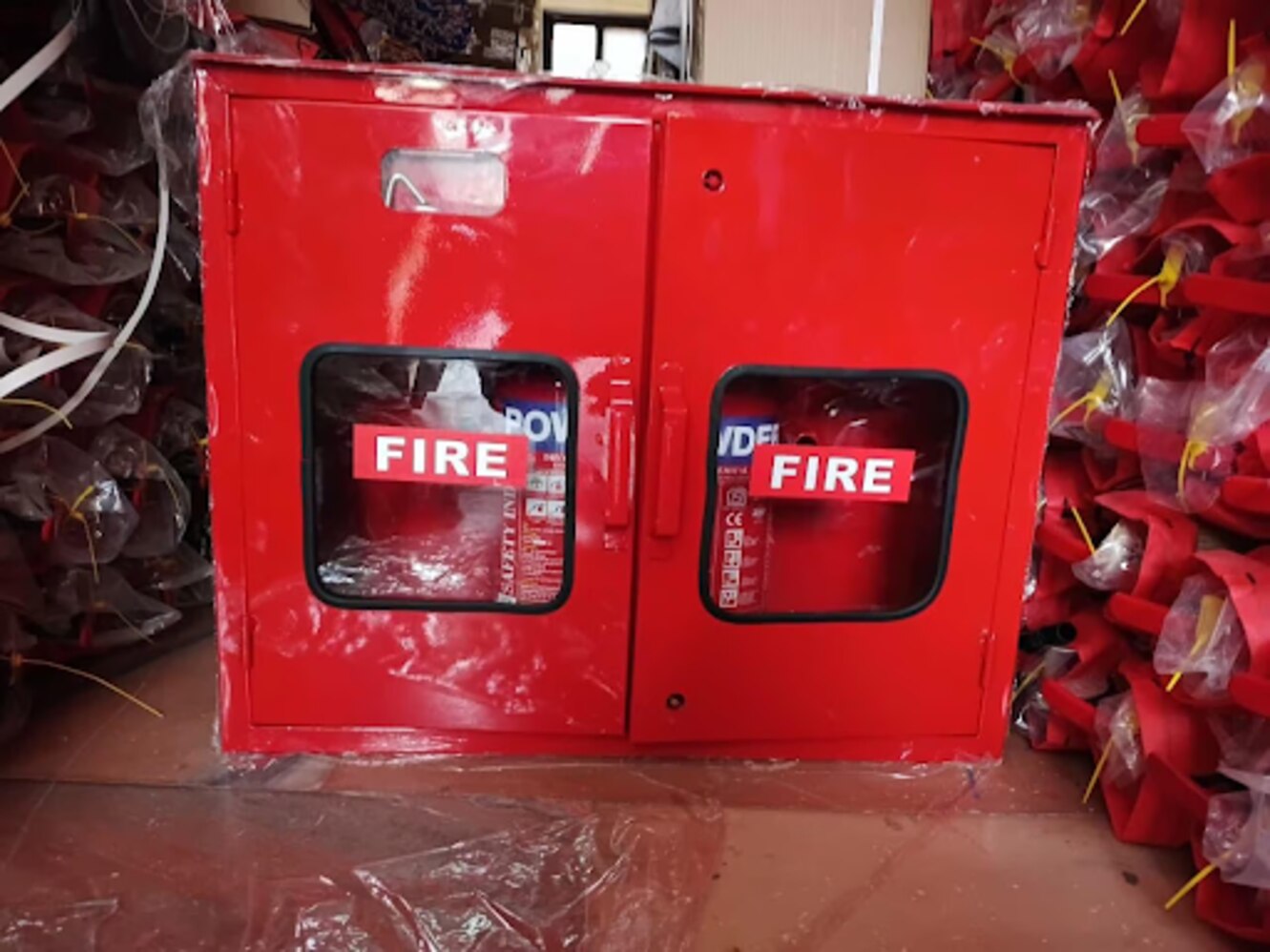
Two doors are justified when the station contains two separate equipment zones that must be reached without reaching around other equipment. One side might hold a hose reel or landing valve; the other might hold an extinguisher, a second hose reel, or a hose-and-nozzle set.
A double door hose box is useful for this paired arrangement, not simply because it is larger.
Specify the intended contents before choosing the cabinet. Reel-mounted hose, folded lay-flat hose, hydrant valves and nozzles need different clearances; forcing folded hose into a tight bend creates kinks that restrict flow and delay deployment. Keep cleaning supplies, tools and spare parts out of both compartments.
| Option | What it holds or describes | When it applies |
|---|---|---|
| Double-door hose cabinet | Two defined equipment zones, such as two reels or a reel and a landing valve | Use when each side needs direct, unobstructed access |
| Single-door hose box | One hose assembly, reel, valve and nozzle set | Use when one assembly fits without reach-around access |
| Open hose rack | Exposed hose supported on a rack, without cabinet doors | Use where environmental protection and tamper control are not required |
| Hose reel cabinet | A reel, hose, nozzle and operating hardware | Use for a reel-only station; do not assume it suits folded hose |
| Recessed fire-hose cabinet | A cabinet set into a wall cavity | Use when corridor projection must be reduced and the wall can accept the recess |
The cabinet is not automatically a compliant hose station. The hose, piping, valve, nozzle, reel, signage and box must form a compatible listed or approved assembly under the adopted standard, with NFPA 14 and NFPA 1962 consulted where applicable.
How to Size the Cabinet Around the Actual Hose Assembly
A cabinet can match the hose length and still fail in use. The hose reel diameter, swing arm, valve position, nozzle projection, coupling and door clearance determine the usable hose box dimensions—not the catalogue label.
1. Measure the installed assembly, not loose components. Record the reel’s outside diameter and width, the fully extended swing-arm envelope, hose diameter, nozzle length, valve handle travel and the minimum bend radius.
For a lay-flat fire hose, measure the folded or rolled package at its largest point and confirm that the coupling and nozzle do not protrude into the door path.
2. Set the internal width and height around the equipment envelope. Add working room beside the valve and nozzle so a person can grip, turn and remove them without shifting another item.
If an extinguisher, second reel or partition shares the box, calculate each zone separately; do not count space occupied by unrelated equipment as access space.
3. Set internal depth from the deepest projection, then add the clearance needed for the door, hinges, glazing and hand access. Check the door at its full opening angle. A shallow box can crush the hose against the door, while an oversized box can bury the nozzle behind a shelf.
4. Compare the resulting clear internal measurements with the supplier’s hose storage cabinet size, then verify the external dimensions against the wall and approach route. Require a drawing showing every component in its installed position and confirm that the cabinet, reel, hose, valve and nozzle form a listed or approved assembly under the adopted standard.
How Mounting, Door Swing and Clearance Affect Access
Install a double-door box on a wall beside the hose station it serves, not where furniture, parked vehicles or stored stock can block it. The wall-mounted hose box needs a structurally sound fixing surface that can carry the cabinet, its doors and the installed equipment without loosening or distorting.
Choose a surface-mounted fire hose cabinet when the wall cannot accept a recess or when exposed piping makes a projecting enclosure practical.
Check the projection in an accessible corridor: under the 2010 ADA Standards, an object with a leading edge between 27 and 80 inches above the finished floor cannot protrude more than 4 inches into an accessible route. Local accessibility rules may differ, so measure the finished installation.
Use a recessed fire hose cabinet only where the wall has enough depth and strength for the opening, frame and concealed services. Before cutting, locate electrical conduits, structural reinforcement and fire-rated construction.
Seal the opening with a compatible rated detail where the wall requires fire resistance; a cabinet that weakens the wall can create a larger hazard than the equipment solves.
Provide all of the following before fixing the cabinet:
- A level floor or finished surface that keeps the doors from scraping and leaves the hose, valve and nozzle reachable.
- Door-opening clearance that lets both leaves open fully without striking a wall, handrail, column or vehicle.
- An approach route wide and clear enough for a person to stand at the cabinet and remove equipment.
- No door swing into a stair landing, required exit path or corridor pinch point.
Test the doors with the actual hose reel, nozzle and valve installed. A nominally compliant box becomes unusable when an open leaf blocks the route or the user must reach around equipment.
How to Protect the Equipment Without Locking It Away
A latch must release in one deliberate movement without a key. Specify a fire hose cabinet lock only when the adopted fire code permits it and the access method cannot delay emergency use; a missing key turns protection into a locked cupboard.
1. Choose glazing that allows the hose, nozzle and valve to be checked without opening the door. Ordinary glass can create dangerous shards, so specify safety glazing or an approved break-glass hose cabinet with a visible, attached hammer or other opening device. Never place the hammer inside.
2. Mark the doors with durable, high-contrast “FIRE HOSE” signage visible from the approach route. Keep the label unobstructed and identify the valve or reel inside when several stations are close together. A cabinet hidden behind stock has failed before anyone touches its latch.
3. Provide drainage and ventilation for humid, coastal or wash-down areas, but prevent insects, dirt, unauthorised water entry and freezing exposure. Trapped water corrodes couplings, valves and seams; an unprotected drain creates a different failure.
4. Specify a corrosion-resistant hose box, such as a galvanised steel cabinet with a suitable protective finish, stainless hardware and sealed or protected hinges. Inspect for seized hinges, damaged glazing, leakage and latch operation; a cabinet that opens only with force is not accessible.
Keep the hose coupling, nozzle and valve reachable without removing shelves, extinguishers or other equipment. Security that adds a key search, hidden release or two-handed opening creates a dangerous delay.
How to Verify the Cabinet as Part of a Complete Hose Station
Treat the cabinet as reliable only after a fire hose cabinet inspection confirms that every component works together and the connected system has been commissioned. The box alone supplies neither water pressure nor firefighting capability.
1. Open both doors fully and check hinges, latch, glazing, corrosion, signage and obstructions. Pull out the hose, rotate the reel, operate the nozzle and confirm the valve is reachable without removing stored items.
2. Match the equipment to the approved design: hose type and diameter, hose length, reel, nozzle, landing valve, pipe connection and cabinet dimensions. Occupant-use hose reels are not interchangeable with fire-department attack hose.
3. Ask the fire hose station supplier for the cabinet’s material and coating specification, drawings showing the equipment arrangement, product listing or approval documents, and compatibility details for the hose, reel, nozzle and valve. Confirm the door swing against local fire, building and accessibility rules.
4. Request system records showing flow and pressure at the station, pump and standpipe commissioning results, and the inspection and service history for the hose under NFPA 14 and NFPA 1962. A hose with cracked jackets, damaged couplings, a blocked nozzle or leakage fails the station’s purpose.
Safety India Service can help you compare a double-door box with the actual hose-and-valve arrangement, but the final acceptance still belongs to the project’s designer, authority having jurisdiction and documented commissioning records. Keep each compartment limited to its defined equipment; cleaning supplies and spare parts can conceal defects and delay deployment.
Related product
 | Double Door Hose Box The Double Door Hose Box by Safety India Service is a robust and reliable fire safety storage solution designed to keep fire hoses protected,... View product → |
Frequently asked questions
What is a double-door hose box designed to hold?
It holds two separate equipment zones, such as a hose reel or landing valve on one side and an extinguisher or hose-and-nozzle set on the other.
How do you size a double-door hose box?
Measure the complete hose assembly, including the reel, nozzle, valve, couplings and operating space, then choose a cabinet that allows removal without reaching around other equipment.
What mounting and clearance details affect access?
Check the mounting height, door swing, handle position and surrounding clearance so both doors open fully and users can reach the hose, nozzle and valve directly.
How can you protect equipment without locking it away?
Use a sturdy, visible cabinet with secure doors that protect against damage while allowing rapid emergency opening and clear access to every component.