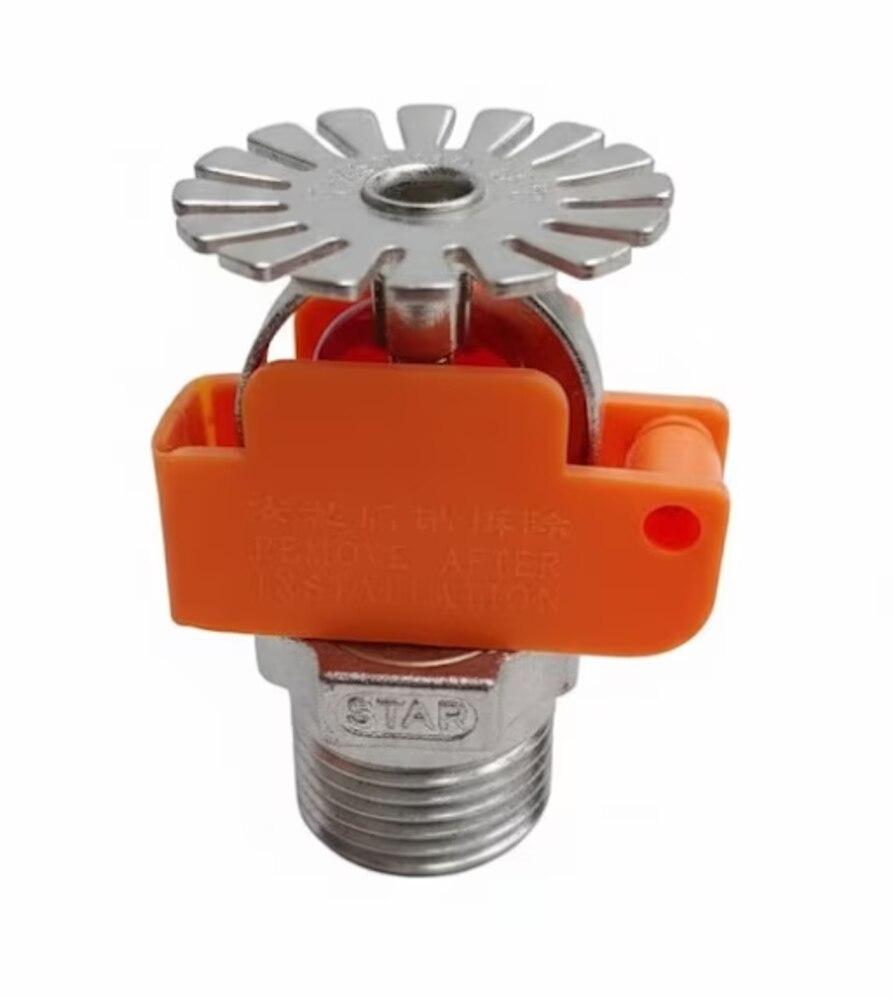
A pendent sprinkler is suitable in many occupied and industrial spaces, but its downward orientation does not determine whether the head fits the hazard. By the end, you will be able to identify appropriate locations, recognise installation constraints, and distinguish a standard pendent from alternatives required by temperature, storage, freezing, or system conditions.
Key takeaways
- Use pendent sprinklers where downward water distribution suits the ceiling and floor layout.
- Check storage height, commodity type and obstructions before industrial installation.
- Compare pendent, upright, sidewall and concealed sprinklers by ceiling and pipe arrangement.
- Verify the sprinkler’s temperature rating, approval, thread and replacement compatibility.
Where pendent sprinklers fit in commercial buildings
Below-pipe installation makes the pendent sprinkler a practical choice for many commercial fire protection layouts. Its downward-facing deflector spreads water across the floor area beneath the head, rather than across the wall.
That pattern suits office sprinkler systems, corridors, retail sales floors, hotels, hospitals, and classrooms when the selected model is listed for the occupancy and layout.
| Space | Why pendent fits | Ceiling condition |
|---|---|---|
| Offices and corridors | Directs water into occupied travel and work areas | Exposed slabs or suspended ceilings |
| Retail areas and hotels | Supports regular, below-pipe coverage across sales rooms, guest rooms, and public areas | Flat ceilings with approved spacing |
| Hospitals and classrooms | Keeps discharge directed over beds, desks, and circulation areas | Suspended grids or exposed ceilings |
| Rooms with exposed or suspended ceilings | Places heads beneath the branch line and distributes water downward | Verify obstructions and ceiling height |
Under an unobstructed ceiling, standard-spray pendent sprinklers are commonly installed with the deflector approximately 1–12 inches below the ceiling. The downward deflector must remain positioned to develop the listed spray pattern; a beam, joist, light fitting, duct, or dropped ceiling can change the arrangement.
The 1–12-inch range is not a blanket permission created by the word pendent. Use the individual sprinkler’s listing and data sheet for the allowed distance, spacing, coverage, temperature rating, and obstruction rules. Pendent identifies orientation only—not hazard class, response type, K-factor, or water demand—so a residential pendent and a commercial standard-spray pendent are not interchangeable.
Industrial locations that need a different suitability check
Pendent sprinklers serve production floors, storage areas, loading zones, workshops, and process spaces where overhead fire risks require downward water distribution. A standard head becomes unsuitable when temperature, freezing, contamination, corrosion, weather exposure, or the fuel arrangement exceeds its listing.
1. Use a dry pendent sprinkler for a freezing room or unheated section when the branch line remains in a heated space. Its barrel extends into the cold area and keeps water out of the freezing portion; match its length, inlet connection, orientation, and installation details to the listing.
2. Review dusty production areas, chemical rooms, wash-down zones, and corrosive-vapour spaces before selecting a head. Dust can contaminate the thermal element or deflector, while aggressive vapours can attack components. Specify a factory-listed corrosion-resistant finish or corrosion-resistant material; field-applied paint or tape is not an equivalent repair.
3. Check the maximum temperature at the sprinkler, not the room average. Furnaces, heaters, hot-air discharge, process equipment, and skylights can require intermediate- or higher-temperature ratings where a local heat source exceeds an ordinary sprinkler’s limit.
4. Treat outdoor loading areas, canopies, and exposed process structures as separate design problems. Wind, freezing, weather, and changing heat conditions can make a wet-system head unsuitable and require a listed dry, pre-action, or otherwise approved arrangement.
Industrial fire protection design must also match storage height, fuel type, water demand, and obstruction conditions. Production floor sprinklers and warehouse sprinkler systems are not interchangeable merely because both are pendent.
How ceilings, storage and obstructions determine placement
Hazard classification and fuel load decide whether a pendent sprinkler is suitable, not ceiling area alone. Classify the occupancy, account for combustible contents, and match storage height, rack arrangement, ceiling construction, required design density, water supply and the sprinkler’s listed coverage through the NFPA 13 design.
Storage racks and sprinklers require coordinated spacing. High-piled commodities, narrow flue spaces, solid shelves and ceiling heights beyond the sprinkler listing can demand in-rack sprinklers, ESFR protection or another listed arrangement. A standard-spray pendent head is not automatically suitable for storage protection.
Check these conditions before fixing locations:
- Beams, ducts, cable trays, lights and signs can block the spray pattern.
- Suspended ceilings can change the discharge plane; concealed spaces above them can require separate protection.
- High-bay equipment can create a shadow below the deflector and obstruct heat movement.
- A larger K-factor increases flow at a given pressure, but does not correct coverage, obstruction or listing limits.
| Obstruction condition | Possible remedy | Why the simple fix fails |
|---|---|---|
| Beam or duct near deflector | Relocate the head or add listed sprinklers | The blocked pattern leaves unprotected floor area |
| Cable tray, light or sign | Adjust spacing or use an approved arrangement | A head below it may still miss the remote area |
| High-bay equipment or rack | Add in-rack protection or select a storage-listed system | Ceiling discharge may not penetrate the storage |
| Concealed ceiling space | Protect the space or use a listed concealed arrangement | Fire can spread above the visible ceiling |
The final layout must satisfy hydraulic demand and the individual sprinkler listing. Placement below an obstruction is not automatically compliant.
How pendent heads differ from other sprinkler arrangements
Pendent identifies orientation only: the sprinkler hangs below the branch line and its deflector sends water downward. It does not specify hazard class, response type, K-factor, temperature rating, or approved use.
| Arrangement or system | What distinguishes it | When it applies |
|---|---|---|
| Standard pendent sprinkler | Installs below the pipe and discharges downward through its listed deflector | Ordinary wet-system protection where the listing and hydraulic design fit the hazard |
| Upright sprinkler | Mounts above the pipe, with the deflector above the fitting | Exposed piping or locations where an upright pattern and clearance are suitable |
| Sidewall sprinkler | Discharges across the room from a wall rather than straight down | Areas where ceiling piping is impractical and the listed sidewall pattern fits |
| Concealed pendent sprinkler | Uses a sprinkler and listed cover plate tested as one assembly | Finished ceilings; field painting or substituting the cover plate can invalidate the listing |
| Dry pendent sprinkler | Uses a barrel extending into a freezing area from a heated branch line | Protects cold rooms while keeping water out of the freezing section; barrel length, inlet, and installation matter |
| Wet-pipe system | Water remains in the piping and flows when heat opens the sprinkler | Heated spaces with no freezing exposure |
| Dry-pipe system | Air or nitrogen holds water behind a valve until operation | Unheated spaces where filled piping could freeze |
| Pre-action system | Detection opens the valve before sprinkler operation admits water | Water-sensitive areas needing controlled water entry |
| Deluge system | Open sprinklers discharge together after detection opens the valve | Rapid, comprehensive application over defined high-hazard areas |
| ESFR sprinkler systems | Pendent suppression sprinklers deliver high flow for tested storage scenarios | Defined commodity, storage height, ceiling, rack, elevation, and water-supply conditions—not a universal upgrade |
A residential pendent sprinkler is also not interchangeable with a commercial standard-spray head. Selection must follow the individual listing and the system design.
What to verify before specifying or replacing a pendent sprinkler
Do not replace a pendent sprinkler by appearance alone. “Pendent” describes downward orientation, not the sprinkler’s performance or approved use. Check the individual sprinkler listing and data sheet for:
- K-factor and response type
- Temperature rating and orientation
- Listed coverage and approved occupancy or storage use
- Finish, coating, and corrosion resistance
- Compatibility with the pipe, fittings, cover plate, and system design
The hydraulic relationship is Q = K√P: flow rate equals K-factor multiplied by the square root of pressure. At the same pressure, a larger K-factor delivers more water and changes the system’s hydraulic demand; substituting one can invalidate the original calculation.
Residential and commercial listings are not interchangeable because their discharge patterns, response characteristics, spacing rules, and approved applications differ.
| Check | NFPA 13 | NFPA 25 |
|---|---|---|
| Main purpose | Design and installation of the water-based system | Inspection, testing, and maintenance after installation |
| Replacement decision | Confirm the listed head matches the hydraulic design | Check condition, obstruction, damage, and required testing |
| Authority to change models | Requires design review and listing compatibility | Does not authorize an unverified model change |
Never field-paint a sprinkler or substitute an unlisted cover plate; either change can invalidate the listed assembly. Ask Safety India Service to provide a compatible, certified head and have the fire-protection designer review the replacement before installation.
Related product
 | Pendent Sprinkler The Pendent Sprinkler from Safety India Service is a reliable and high-performance fire-protection device designed for maximum safety in residential,... View product → |
Frequently asked questions
Where are pendent sprinklers used in commercial buildings?
Pendent sprinklers suit many offices, retail spaces, hotels and other commercial areas with unobstructed ceilings and below-ceiling pipework.
When does an industrial site need a different suitability check?
Check the storage height, stored commodity, rack arrangement, ceiling height, temperature and expected fire behaviour before choosing a pendent sprinkler.
How do ceilings, storage and obstructions affect pendent sprinkler placement?
Beams, ducts, lights, suspended ceilings and tall storage can block water distribution, so placement and spacing must match the system design.
What should you verify before specifying or replacing a pendent sprinkler?
Confirm the sprinkler type, temperature rating, approval, orifice, thread size, orientation and compatibility with the existing pipework and design.