A foam extinguisher is useful for the right small fire, but “flammable liquid” covers hazards that behave very differently. You will learn how to identify Class A and Class B risks, apply foam without spreading a spill, and choose another agent when electricity, cooking oil, solvents, gases or deep-seated materials change the decision.
Key takeaways
- Use foam on Class A materials and suitable Class B flammable liquids.
- Apply foam gently across the liquid surface; never spray directly into the fuel.
- Choose CO2 for live electrical equipment and wet chemical for cooking-oil fires.
- Reject units with damaged seals, missing service records or incompatible fire ratings.
Which fire classes can a foam extinguisher handle?
A Class A fire involves ordinary combustibles such as wood, paper, cloth and many plastics. A Class B fire involves flammable liquids such as petrol, diesel, solvents, paints and oils.
| Class | Typical fuel | Foam suitability |
|---|---|---|
| Class A | Wood, paper, cloth, many plastics | Many Class A fires, within the marked Class A rating |
| Class B | Petrol, diesel, solvents, paints, oils | Many surface-level hydrocarbon fires, within the marked Class B rating |
Foam forms a blanket over a burning liquid, reducing vapour release and separating the fuel from air while cooling the surface. The cylinder’s permanent numerical Class A and Class B ratings limit the fire size it has been tested to handle; “suitable for liquid fires” is not a sufficient claim.
Ratings are not interchangeable across jurisdictions. US extinguishers commonly follow NFPA 10 and UL 711-related rating practice, while Europe and many other markets use EN 3 markings with separate Class A and Class B ratings.
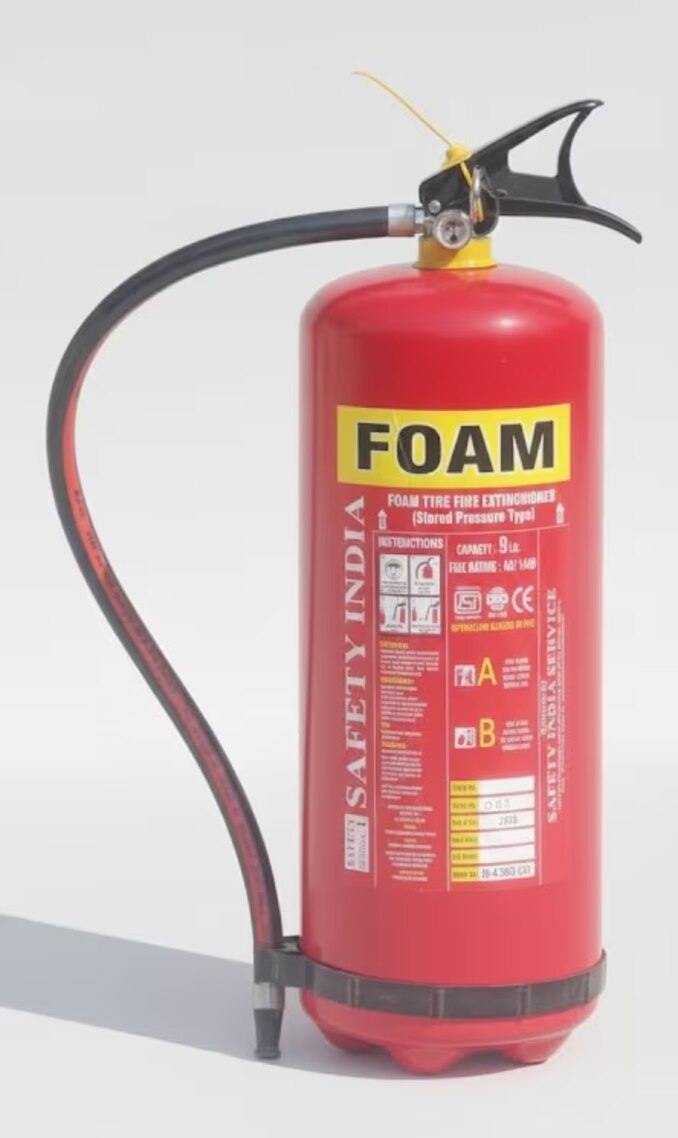
Before relying on one, inspect the cylinder label, fire-class symbols, numerical rating, agent type and application limitations. A rating does not make foam suitable for energised electrical equipment, cooking oil, flammable gas or combustible-metal fires.
Use an extinguisher explicitly approved for that hazard, isolate electrical power first, and choose Class K or Class F equipment for cooking-oil fires.
How do you apply foam to a small liquid or Class A fire?
Use a foam extinguisher only on a small, approachable fire within its tested Class A or Class B rating. For how to use a foam fire extinguisher safely, keep an unobstructed escape route behind you and never trade that route for a closer position.
- Raise the alarm and call emergency services. Confirm that the fire is small enough for the extinguisher’s permanent rating.
- Approach only from a safe distance with your escape route clear. Remove the safety pin or tamper seal, then test the handle according to the manufacturer’s instructions.
- For a liquid spill fire, use near-edge application. Aim at the near edge, or at a nearby wall, floor or other surface, so foam flows gently across the fuel.
- Sweep across the liquid surface while keeping your retreat path open. Do not drive a high-velocity jet into the centre; turbulence can break the foam blanket, spread burning fuel and push flames across the spill.
- On Class A material such as paper, cloth or wood, aim at the base of the flames. Continue long enough to cool the material because porous stacks can retain hidden embers beneath the surface.
The foam blanket suppresses vapour release and separates fuel from air, while its water content provides cooling. Withdraw immediately if flames grow, smoke hides the exit, fuel continues to run or leak, the fire reaches the ceiling, or the extinguisher fails to control it.
When should you choose water, powder, CO2 or wet chemical instead?
Choose water for many Class A fires, foam for rated Class A and surface-level Class B fires, and another agent when electricity or cooking oil changes the hazard.
| Option | Main strength | Do not choose it for |
|---|---|---|
| Foam | Cools ordinary combustibles and blankets flammable-liquid surfaces | Energised electrical equipment or deep-fat fryers unless the label explicitly approves that use |
| Water | Cools wood, paper, cloth and similar Class A material | Burning flammable liquids, live electrical equipment or hot cooking oil |
| ABC dry powder extinguisher | Covers many Class A, B and C risks | Areas where corrosive, difficult-to-clean residue or reduced visibility creates a serious problem |
| CO2 fire extinguisher | Suits energised electrical equipment and leaves no residue | Outdoor fires in wind or deep-seated Class A material that needs cooling |
| Wet chemical extinguisher | Controls hot cooking oil and fat | Hazards outside its marked cooking-fire classification |
The foam versus water extinguisher decision turns on how the agent controls the fire: water removes heat, while foam also suppresses flammable vapour. ABC dry powder gives broader coverage, but powder contamination can damage equipment and obscure your view. A CO2 fire extinguisher disperses quickly outdoors and does not cool buried embers.
Do not use ordinary foam on energised electrical equipment unless the extinguisher is explicitly approved and marked for it. Isolate the power first, then use the agent selected for the equipment. Never use water or an unsuitable water-based agent on a deep-fat fryer; violent boil-over and fire spread can result.
Use a wet chemical extinguisher classified as Class K in North America or Class F in Europe.
What liquid and fire conditions exceed foam’s practical limits?
A manageable foam fire is a small, surface-level hydrocarbon spill within the extinguisher’s tested rating, with a clear escape route behind you. Foam exceeds its practical limits when fuel is pressurised, leaking, flowing, burning in three dimensions or supplied by a gas cylinder or process line; isolate the fuel and call specialist responders instead.
Standard mechanical foam for petrol, diesel and similar hydrocarbons is not automatically suitable for polar solvents. Ethanol, methanol, acetone, other ketones and some ethers can destroy or penetrate the blanket, so use alcohol-resistant foam or another solvent-rated formulation exactly as specified for that fuel.
Foam is a poor substitute for fixed suppression or emergency shutdown when the release continues. Wind, drainage, walking through the spill and nozzle turbulence can break the blanket, while continuing fuel release defeats it.
- Evacuate and call emergency services for a growing spill, multiple hazard classes, a blocked exit, heavy smoke, a pressurised source, or flames beyond the extinguisher’s rating.
- Do not treat vanished flames as proof of safety. Hot surfaces and continuing vapour can cause re-ignition.
- On Class A materials, surface foam may knock down flames without reaching embers deep inside stacked paper, cloth, wood or other porous material. Withdraw if burning returns or hidden heat persists.
A pressurised gas fire is not a foam-extinguisher job, and a three-dimensional fire around pipes, machinery or flowing fuel requires isolation and specialist response.
How should you select, inspect and document a foam extinguisher?
Match the permanently marked Class A and Class B ratings to the anticipated fire size; a “multi-purpose” claim is not evidence. Confirm the agent type and site compatibility before buying.
- Check electrical equipment, cooking oils, flammable gases, process chemicals, drainage and access hazards; foam is not automatically suitable for any of them.
- Ask Safety India Service 27CNOPP6823R1ZV for the product data sheet, rating evidence, agent chemistry, operating-temperature range, recharge procedure and disposal route.
- Record the cylinder serial number, location, ratings, agent, purchase date, inspection dates, defects, recharge work and next service due date.
Hydrocarbon foam and alcohol-resistant foam are not interchangeable.
| Agent | Verify | Failure if mismatched |
|---|---|---|
| Hydrocarbon foam | Petrol, diesel, oils and other non-polar liquids | A solvent can destroy the blanket |
| Alcohol-resistant foam | Ethanol, methanol, acetone and other polar solvents | Vapour release and re-ignition can continue |
| Fluorine-free foam | Chemistry, tested rating and disposal route | Environmental controls can still apply |
Premixed foam and concentrates have finite service lives. Freezing, evaporation, corrosion, microbial degradation or concentration changes can make a full cylinder ineffective, so follow the manufacturer’s storage, temperature, inspection and recharge instructions.
During each fire extinguisher inspection, examine the cylinder, hose, nozzle, pressure indicator, pin, tamper seal, label and mounting location. Document damage or pressure loss and remove the unit from service. AFFF and PFAS-containing legacy agents can create discharge, restriction and waste obligations unlike fluorine-free foam; verify local controls before disposal.
Use foam only on a small, approachable fire within its rating. Never delay evacuation or emergency response.
Related product
 | Foam Fire Extinguisher Safety India Services Foam Fire Extinguishers provide a fast, powerful means of tackling flammable liquids. View product → |
Frequently asked questions
Which fire classes can a foam extinguisher handle?
Foam extinguishers are designed for Class A fires involving wood, paper, cloth and some plastics, plus Class B fires involving suitable flammable liquids such as petrol, diesel, solvents, paints and oils. Check the extinguisher’s printed fire-rating symbols before use.
How do you apply foam to a small liquid or Class A fire?
Raise the alarm, keep an escape route behind you and use the extinguisher from a safe distance. For a liquid fire, aim at the inside edge of the container or nearby surface so foam flows over the fuel; do not blast the liquid directly. For Class A materials, sweep across the base and watch for re-ignition.
When should you choose water, powder, CO2 or wet chemical instead?
Use water for Class A materials when no electrical or flammable-liquid hazard exists. Use dry powder for flammable gases and situations where rapid knockdown matters, but account for poor visibility and residue. Use CO2 on energised electrical equipment and clean, contained flammable-liquid fires. Use wet chemical for cooking oils and fats.
What liquid and fire conditions exceed foam’s practical limits?
Do not rely on standard foam for energised electrical equipment, burning gases, cooking oils and fats, or fires involving reactive metals. Avoid using it when the fire is spreading, producing heavy smoke, blocking your escape route or exceeding the extinguisher’s printed rating.
How should you select, inspect and document a foam extinguisher?
Match the unit’s Class A and Class B ratings to the hazards, confirm the agent is compatible with the fuel, and check the pressure indicator, hose, pin, tamper seal, cylinder and label. Record the serial number, location, inspection date, defects, corrective action and service provider. Follow the manufacturer’s instructions and the inspection requirements that apply at your site.