A pendent sprinkler is selected by more than its downward-facing shape: its listing, temperature rating, discharge pattern, hazard classification, ceiling arrangement, and hydraulic design all determine where it belongs. By the end, you will be able to match pendent sprinkler types to commercial and industrial spaces, identify layout risks, and know which details require approval under IS 15105, NFPA 13, or the project’s adopted fire-protection specification.
Key takeaways
- Match sprinkler temperature rating and discharge pattern to the fire hazard.
- Check ceiling height, spacing, beams, ducts, lights, and storage obstructions.
- Select concealed, recessed, or standard pendent forms for site conditions.
- Approve hydraulic calculations, layout drawings, and component compatibility before ordering.
How a Pendent Sprinkler Operates Above a Finished Ceiling
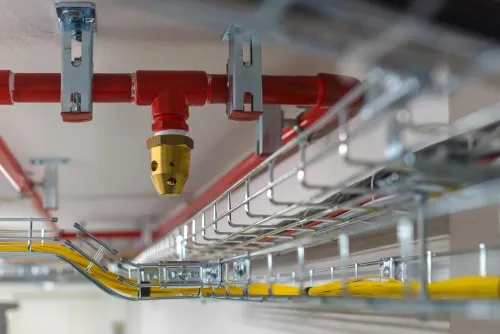
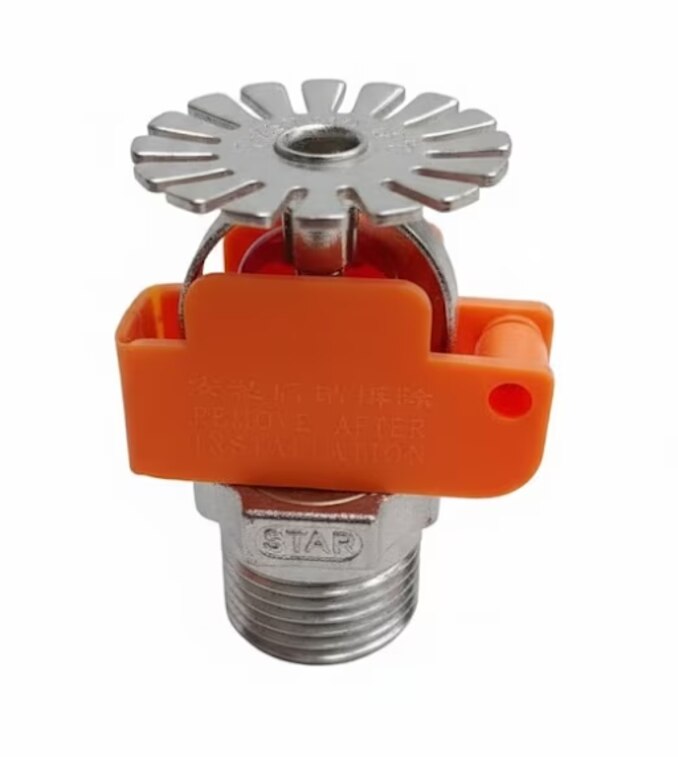
A pendent sprinkler hangs below its water connection, with the pipe and fitting concealed above the finished ceiling and the deflector facing downward. This downward-facing sprinkler has a frame, a heat-sensitive glass bulb or fusible element, a seal, and a deflector that spreads water across the protected area.
Common locations include:
- Offices, hotels, and corridors
- Retail floors and commercial rooms
- Warehouses and storage rooms
- Production areas and ceilinged plant spaces
A glass bulb sprinkler activates when heat raises the liquid inside the bulb to its rated temperature, causing the bulb to break. Fusible element sprinkler operation begins when heat melts the alloy holding the element together.
In either design, the seal opens and pressurised water flows through that individual sprinkler; nearby heads do not discharge unless heat activates them.
The water pattern depends on the sprinkler listing, deflector position, ceiling distance, temperature rating, and required design density. A standard-spray pendent sprinkler is not automatically suitable for high storage or industrial hazards.
A concealed pendent sprinkler must retain its listed cover plate and clearance; painting the plate, substituting a similar cover, or blocking it can delay operation.Winvalid?
Matching Pendent Sprinklers to Occupancy and Fire Hazard
Offices, retail floors, hotel rooms, corridors, classrooms, and other ceilinged spaces suit pendent sprinklers when their contents and activities fit the approved hazard classification. Typical commercial pendent sprinkler applications fall within light-hazard occupancy, where combustible materials and fire growth are limited.
| Occupancy or condition | Suitable examples | Selection basis | What changes the decision |
|---|---|---|---|
| Light-hazard occupancy | Offices, hotels, corridors, classrooms | Lower design density and suitable ceiling conditions | Heat from equipment, obstructions, or unusual fuel loads |
| Ordinary-hazard occupancy | Workshops, service areas, loading areas, commercial kitchens, plant rooms | Greater combustible loading or process risk | Group 1 or Group 2 classification, ceiling height, and water demand |
| Storage or high-challenge area | Warehouses, rack storage, high-piled plastics | Commodity, storage height, aisle layout, and listed sprinkler type | CMSA, ESFR, or another NFPA 13 design method may be required |
Industrial sprinkler systems can use pendent heads in production rooms, enclosed plant spaces, and storage rooms, but a standard-spray pendent is not automatically suitable for storage protection. High-piled cartons, plastics, rack storage, flammable processes, and tall ceilings require the sprinkler listing and hydraulic criteria specified for that hazard.
Room size alone does not set the choice. The design depends on hazard classification, required density, ceiling construction, obstructions, sprinkler listing, storage arrangement, and available water pressure and flow. The frequently quoted 225-square-foot figure is not a universal allowance.
Quick response also improves response time only where the applicable design standard permits it; it does not make the sprinkler suitable for every hazard.
Coverage, Spacing, Ceiling Height, and Obstructions
A fixed 225 square feet per head is not a universal allowance. The layout starts with these inputs:
- Hazard classification and required design density
- Sprinkler listing and coverage class
- Ceiling construction and room geometry
- NFPA 13 design method: density/area, room design, CMSA, or ESFR
A standard-coverage sprinkler protects only its listed area at its listed spacing. An extended-coverage sprinkler covers a larger listed area only at the specified pressure, spacing, and ceiling conditions. Do not treat either as interchangeable with an ESFR pendent sprinkler, which uses high discharge rates and large droplets for listed storage hazards.
Storage protection requires a separate check. Match the sprinkler to the commodity classification, storage arrangement, storage height, ceiling height, aisle geometry, and hydraulic criteria. Changing an ESFR K-factor, ceiling height, or rack layout invalidates the listed design basis.
Keep the deflector at the distance from the ceiling specified by NFPA 13 and the manufacturer’s listing. Flush mounting, excessive drop, or an unlisted vertical position changes the discharge pattern and ceiling-jet interaction.
Obstructions can make correct sprinkler spacing fail. Check for these before fixing the grid:
- Deep beams, ducts, cable trays, lights, signs, and fans
- Pipe racks and storage racks
- Relocation, additional sprinklers, revised spacing, or a sprinkler listed for the obstruction
Increasing water pressure alone does not correct blocked spray.
Choosing the Right Pendent Form for the Building Conditions
A conventional standard-spray pendent is the default only when the hazard, ceiling, temperature, spacing, and water supply match its listing. Choose another form when the building condition changes; orientation alone does not establish performance.
| Option | What it means | When it applies |
|---|---|---|
| Standard-spray pendent | Downward deflector for ordinary spray distribution | Offices, retail, hotels, and other spaces whose occupancy and storage design match the listing |
| Quick-response pendent | Faster heat response than standard-response models | Occupancies where the applicable NFPA 13 design permits quick response; it is not a substitute for storage-rated protection |
| Concealed pendent sprinkler | Listed sprinkler with a matching cover plate | Finished ceilings where appearance matters; never paint, replace, or obstruct the listed cover |
| Dry pendent sprinkler | Pendent barrel connected to a dry-pipe system | Unheated rooms or freezer areas where water-filled piping could freeze |
| ESFR pendent sprinkler | High-flow, large-droplet suppression sprinkler | Listed high-challenge storage arrangements; match K-factor, pressure, ceiling height, commodity, and storage height exactly |
| Upright sprinkler | Deflector faces upward above exposed piping | Areas without finished ceilings or where beams and services make pendent discharge unsuitable; compare upright versus pendent sprinkler listings |
| Sidewall sprinkler | Throws water outward from a wall | Narrow rooms, corridors, or locations where ceiling piping is impractical |
| CMSA or residential model | Application-specific spray pattern | Storage or residential protection only when its separate listing and design criteria apply |
A dry pendent sprinkler does not solve every cold-space problem: verify barrel length, temperature rating, and system design. Select the listed form before layout, because changing the head after hydraulic calculations can invalidate the design.
Verifying the Design Before Equipment Is Ordered or Installed
A selected head is acceptable only when the design calculation, site conditions, and purchased assembly agree. The K-factor sprinkler calculation must use the listed K-factor, discharge coefficient, and required pressure: Q = K√P. A larger K-factor is not a substitute unless the sprinkler hydraulic design is recalculated and its listing permits the change.
Check these records before ordering:
- Sprinkler temperature rating matches the highest ambient temperature near heaters, skylights, or process equipment.
- The design identifies hazard classification, density or flow demand, spacing, ceiling height, obstructions, and the correct pendent type.
- The water supply provides calculated sprinkler demand plus the required hose-stream allowance, at the required residual pressure, flow, and duration.
- Tank capacity, pump duty, control-valve supervision, water-storage duration, and test-drain results match the design.
- The drawings and calculations identify compliance with IS 15105 sprinkler system requirements and show pipe sizes, branch lines, elevations, and remote-area calculations.
- The purchase specification names the listing, K-factor, response type, temperature rating, finish, thread, cover plate, and quantity.
- Concealed models include the matching listed cover plate; do not paint it or replace it with a similar-looking plate.
| Check | Evidence to obtain | Failure prevented |
|---|---|---|
| Water supply | Flow and pressure test, pump curve, tank calculation | Starved sprinklers or short duration |
| Installation | Reflected ceiling plan and obstruction review | Blocked discharge pattern |
| Procurement | Datasheet, listing, batch and model details | Unapproved substitution |
Safety India Service can help match the ordered pendent sprinkler and accessories to these documented design requirements, rather than treating “pendent” as a complete specification.
Related product
 | Pendent Sprinkler The Pendent Sprinkler from Safety India Service is a reliable and high-performance fire-protection device designed for maximum safety in residential,... View product → |
Frequently asked questions
How does a pendent sprinkler operate above a finished ceiling?
A pendent sprinkler connects to pipework above the ceiling and discharges downward when its heat-sensitive glass bulb or fusible element activates.
How do you match a pendent sprinkler to occupancy and fire hazard?
Classify the occupancy and expected fuel load, then match the sprinkler’s listing, temperature rating, discharge characteristics, and design density to the hazard.
What affects pendent sprinkler coverage and spacing?
Ceiling height, room dimensions, sprinkler spacing, beams, ducts, lighting, soffits, and other obstructions affect coverage and placement.
Which pendent sprinkler form suits a building?
Use standard, recessed, or concealed pendent sprinklers according to ceiling finish, access requirements, environmental exposure, maintenance needs, and approved system design.
What should be verified before pendent sprinklers are ordered or installed?
Verify the approved layout, hydraulic calculations, sprinkler listing, temperature rating, connection size, finish, pipework compatibility, and obstruction clearances.